Our story
Honey, gathered one season at a time.
Behind every jar there is a word, a landscape, a small circle of beekeepers and a great deal of patience. This is our story, in six chapters.
01The name
مَوْسِمmawsimnoun · plural: mawāsim
The time when a thing comes round: the season of a harvest, of the rains, of a gathering.
From the root w-s-m, “to mark”: a mawsim is a marked time, a moment set apart in the year.
Mawsim means season.
We chose the word because it holds everything we believe about honey. Honey is not a recipe that can be repeated at will. It is the record of one place and one moment: the flowers that opened that spring, the weather that held, the patience of the bees.
So we work one season at a time. We jar only what a season gives, we never blend one harvest into another, and every jar carries the name of its season and its number. When a harvest is gone, it is gone — the next will taste of its own year.
02The land
From below the sea to the highlands.
Jordan folds a remarkable range of country into a short drive: the Jordan Valley, the lowest land on earth, and above it the cool highlands of the north and south. Each altitude flowers in its own time.
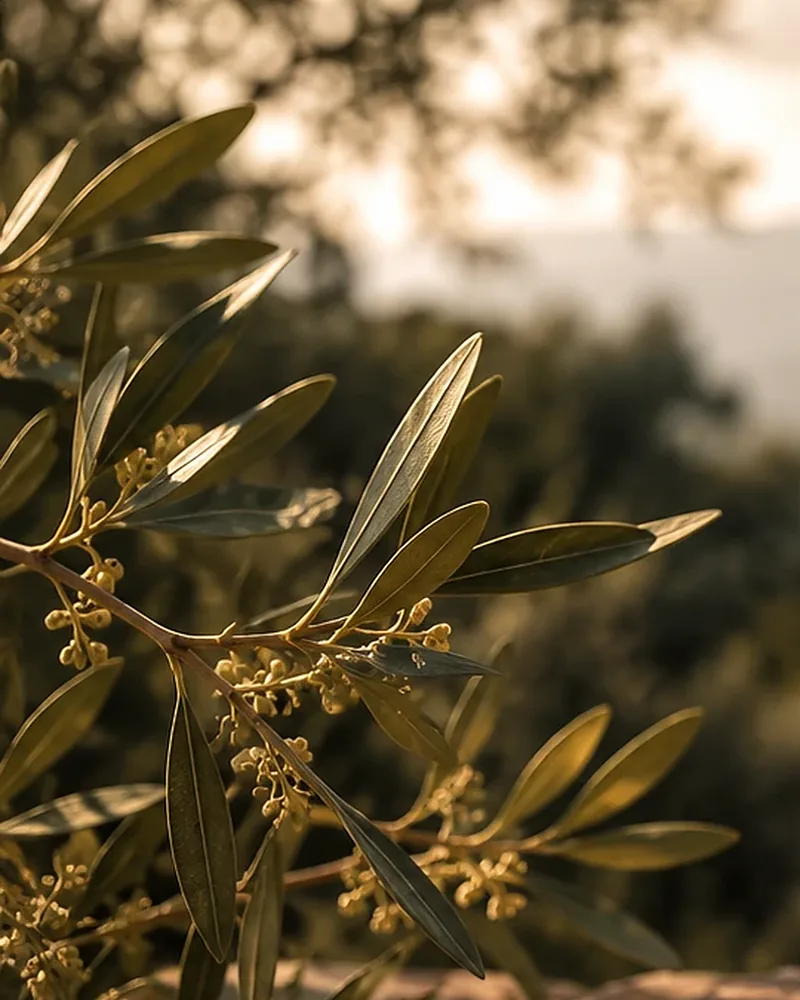
Drive west from Amman and the road keeps falling, past the small sign that marks sea level and on, down into the valley. There, two hundred metres below the sea, spring arrives weeks before it reaches the hills. The air is thick and warm, frost is almost unknown, and the wild sidr flowers in March.
Climb north to the oak and pine of Ajloun, or south to the stony heights above Tafilah, and the year slows down. The same months that close the valley's season open the highlands' — wildflowers first, then thyme among the rocks.
That is why our hives travel, and why every label names a place as well as a honey.
Three altitudes, three seasons
One honey is pouring now; the others are next seasons, written in the land.
-
Sidr
Altitude: −220 m
Jordan Valley — below sea level
Spring 2026
Available now
Discover the harvest -
Wildflower
Altitude: 900 m
Northern highlands — Ajloun
Spring 2027
Expected spring 2027
Join the waitlist -
Wild Thyme
Altitude: 1,100 m
Southern highlands — Tafilah
Summer 2027
Expected summer 2027
Join the waitlist
03The beekeepers
The bees come first.
Our honey is gathered by a small circle of beekeepers who know their valleys by heart — and who measure a good year by the strength of their colonies, not the weight of the harvest.
-
Patience
Frames are lifted only when the bees have capped them in their own time. Nothing is hurried, nothing forced.
-
Respect for nature
Hives rest among wild trees, in the shade, with water close by. We work in the cool of the morning and leave the land as we found it.
-
The bees’ needs first
We take only what the hive can spare and leave the colony its own stores. A strong colony next spring matters more than one more jar today.
The sidr doesn’t hurry, so we don’t either. We waited for the bees to cap every frame in their own time — that patience is what you taste.
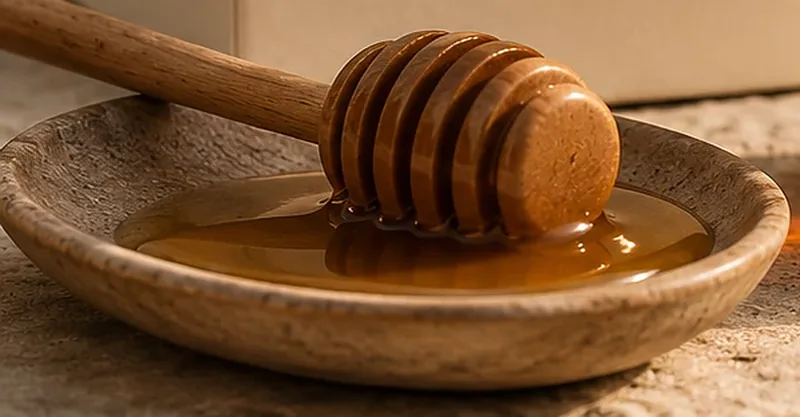
We take only what the hive can spare.
04The right time
Harvested at the right time
From the first flower to the sealed jar, every step waits for the one before it. This is how Harvest 01 came to be.
-
March
Bloom
In the valley’s early warmth, the wild sidr opens thousands of small, green-gold flowers.
-
March – May
Forage
From first light the bees work the blossom, carrying nectar home flower by flower.
-
May
Rest
Inside the hive the nectar ripens slowly, until the bees seal each cell with wax.
-
20 May
Harvest
Only capped frames are lifted — by hand, a few at a time, in the cool of the morning.
-
14 days
Settle
Extracted gently and strained once, the honey rests until it runs clear. Never heated.
-
3 June
Jar
Poured by hand into glass jars: one harvest, never blended with another.
-
1,200 jars
Seal
Each jar is numbered and closed with the harvest strip — a seal of quality and authenticity.
05The craft
A jar made to be kept.
Every detail of the jar was chosen to feel as considered as the honey inside it — and to stay on the shelf long after the last spoonful.
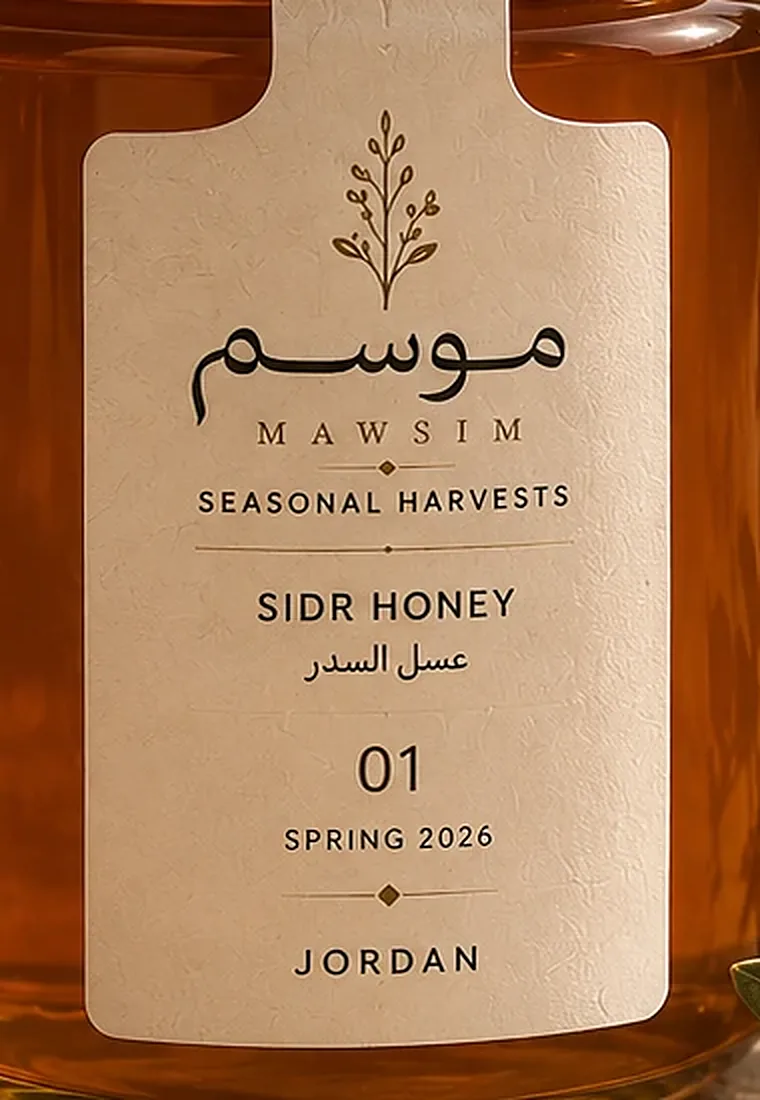
The label, by design
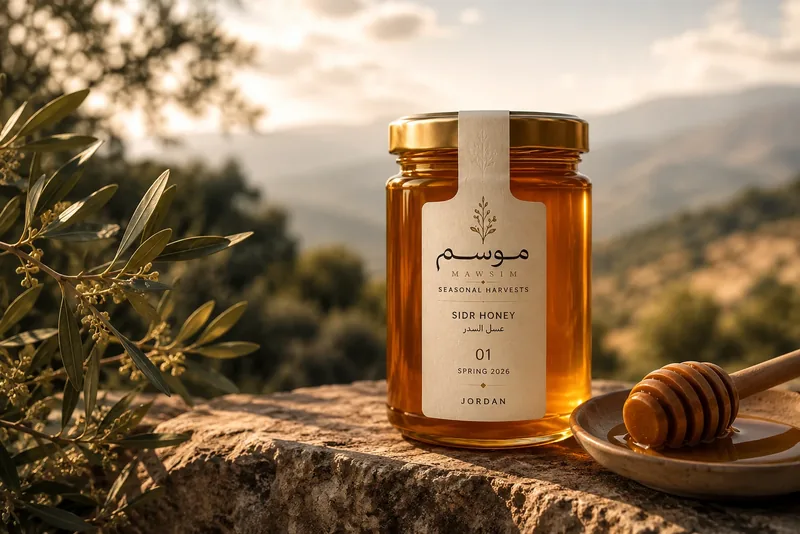
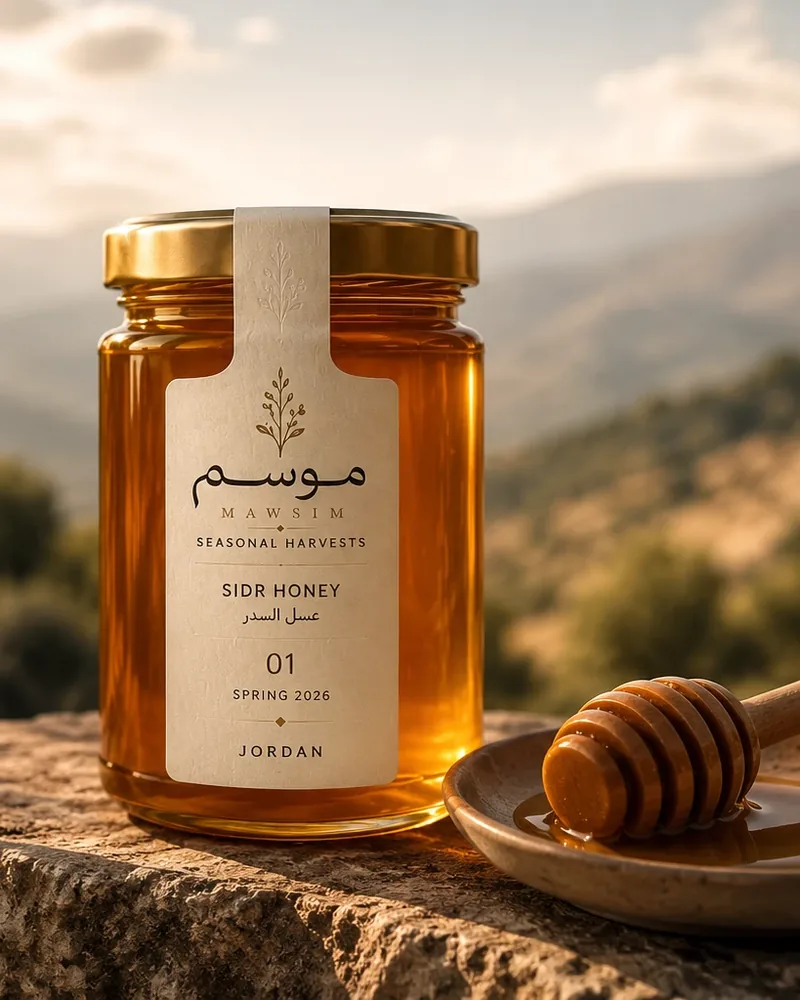
We drew it in the shape of an old bottle tag and cut it from cotton paper. Our two languages share it as equals: «موسم» in calligraphy, MAWSIM in spaced capitals beneath it.
Lower down, the honey and its harvest number are set almost as large as our name. The name stays the same; the season never does.
The 500 g jar
- Net weight
- 500 g
- Dimensions
- 11.3 × 7.5 cm
- Glass
- Premium glass
- Lid
- Matte-gold metal, embossed
- Label
- Cotton paper, soft-touch
- Letterpress and emboss
- Seal
- Embossed harvest strip
-
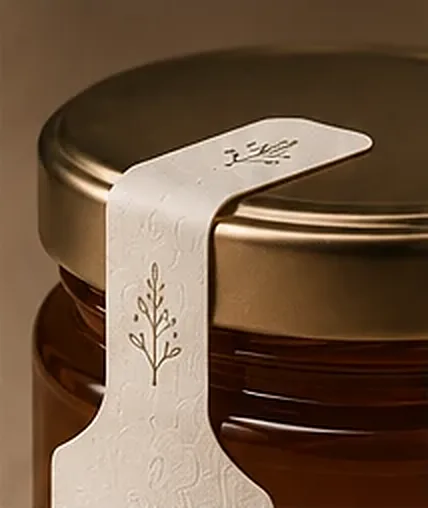
The seal strip
The label’s neck folds over the lid and closes the jar: a seal of quality and authenticity, carrying the code of its Harvest Passport.
-
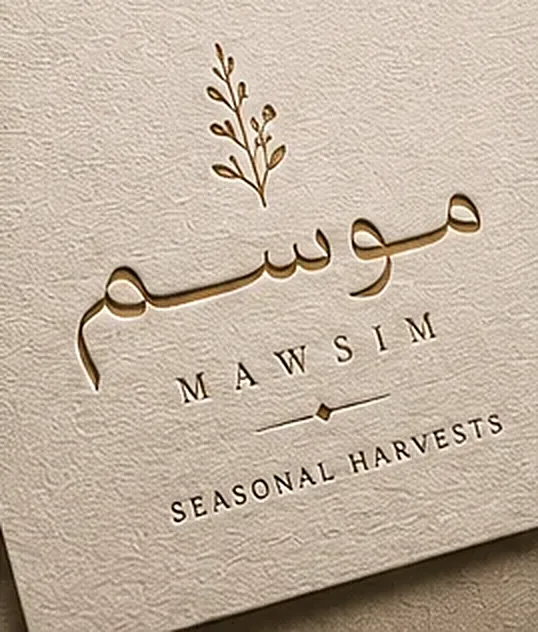
Letterpress and emboss
Cotton paper with a soft, velvety touch. The logo is pressed into it and foiled, so you can read it with your fingertips.
-
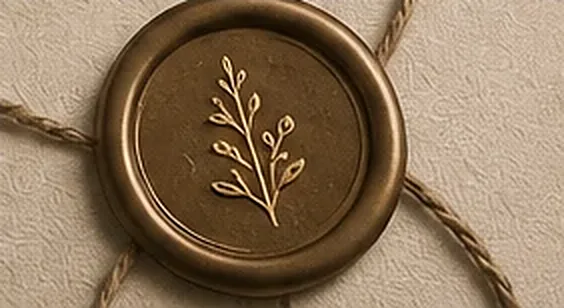
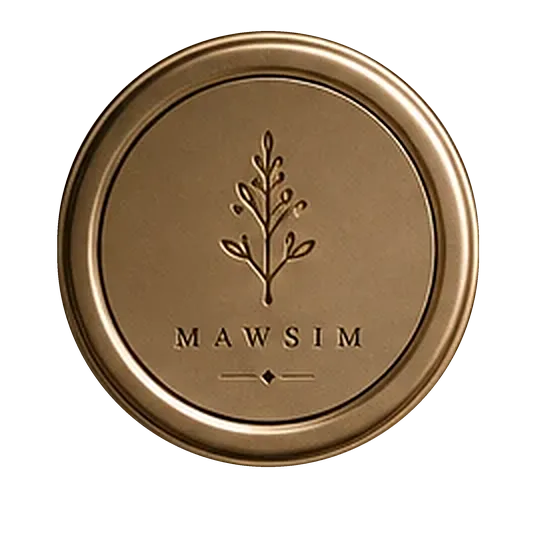
The wax seal
For our gifts, a gold wax seal pressed with the sidr branch and tied with twine — a small ceremony before the first taste.
06The symbol
The sidr branch
- Authenticity
- Nature
- Blessing
The sidr branch symbolises authenticity, nature and blessings.
Every season carries a story that begins with the land.
We drew it as a single, fine branch — leaves, buds and two small fruits — and it appears on every jar, lid and seal we make: the tree that shades the valley, and fed our first harvest.
What we believe
We believe honey is more than food: it is a bond with the land, with nature, and with people. We bring you a fine Jordanian honey, pure as nature… and made with love for the season.
نؤمن أن العسل ليس مجرد طعام، بل هو ارتباط بالأرض، بالطبيعة، وبالناس. نقدم لكم عسلًا أردنيًا فاخرًا، بنقاء الطبيعة… وبحب الموسم.